by aubree davis | Apr 13, 2020 | Devotions
Revelation 1:10-11 I was in the Spirit on the Lord’s Day, and I heard behind me a loud voice, as of a trumpet, 11 saying, “I am the Alpha and the Omega, the First and the Last,” and, “What you see, write in a book and send it to the seven churches which are in Asia: to Ephesus, to Smyrna, to Pergamos, to Thyatira, to Sardis, to Philadelphia, and to Laodicea.
A renewed appreciation of this text is realized when we consider the circumstances. The Roman government had sentenced John to hard labor in the quarries on Patmos Island, a rocky, treeless, 10-mile long island about 60 miles southwest of Ephesus. He was as exile and prisoner, not for any guilt of his own but because of his faithful proclamation of God’s Word.
There are several of you who receive these daily devotional who are going through a difficult season. I want to offer to you some words of encouragement from Revelation chapter 1.
In verse 1 John received a vision of “things which will shortly take place.” I pray for God to help you look beyond the challenges of today, and birth within you a conviction that He is preparing to do something exciting in your life.
In verse 7 he wrote “He [Jesus] is coming.” Talk about something exciting to meditate on, consider the fact that the Lord’s return could be any day.
In verse 11, John was given the assignment to “write what you see and send it to the churches.” Simply stated, God was telling John He was not finished with him. Out of the abandonment and persecution would come an opportunity for ministry to seven churches scattered throughout western Turkey. You may have heard the enemy whisper in your ears, “you’re washed up…you don’t have any ministry left in you…you are done.” Rejoice my friend, for God has not written the final chapter and He still has something He wants you do to do for Him.
Finally, in verses 12 and following, John wrote of receiving a fresh and new glimpse of Jesus. I wonder if the image of Jesus John received at that time reminded him of what he saw when he was with Jesus on the Mount of Transfiguration in Matthew 17. My friend, I pray for God to give to you a fresh and new glimpse of the glory of the Lord.
Let’s sing: “I feel Jesus. I feel Jesus. I feel Jesus in this place. Yes by soul does burn within me. I feel Jesus in this place.”
by aubree davis | Apr 11, 2020 | Devotions
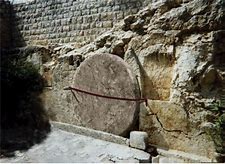 Jesus’ body was placed in the tomb Friday. Romans soldiers guarded it through the day on Saturday (Sabbath). Sabbath ended 6pm & his body was ceremonially treated for burial with spices purchased by Nicodemus (John 19:39-40).
Nicodemus (like Joseph of Arimathea) was a member of the Sanhedrin, the court that had condemned Jesus to death. Neither of them were present during Jesus’ trial. Both men lived as secret followers of Jesus, afraid to make a public profession of faith because of their prominent position in the community. Both men were affected by Jesus’ death, came out of hiding, risking their reputation and lives to do so.
While Jesus’ physical body lay in the tomb, He paid the penalty for sin by offering the perfect, spotless sacrifice. He conquered death, both spiritually and physically, securing our salvation. “For you know that God paid a ransom to save you from the empty life you inherited from your ancestors. And the ransom he paid was not mere gold or silver. He paid for you with the precious lifeblood of Christ, the sinless, spotless Lamb of God.” (1 Peter 1:18-19 NLT).
Let’s sing: “Jesus paid it all, all to Him I owe; sin had left a crimson stain He washed it white as snow…”
by aubree davis | Apr 10, 2020 | Devotions
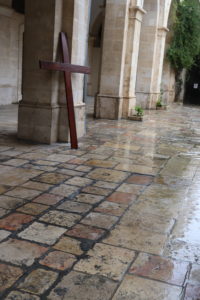 Friday of Holy Week was a day of death. Early Friday morning, Judas, overcome with remorse for betraying our Lord, hanged himself.
By 9am, Jesus had been falsely accused, condemned, mocked, beaten and abandoned. Soldiers spit on Him, tormented Him, and pierced His head with a crown of thorns. He was sentenced to death by crucifixion, one of the most horrible and disgraceful methods of capital punishment known at the time. He carried His own cross to Calvary where He was again mocked & insulted as Roman soldiers nailed Him to a wooden cross. Jesus’ first words on the cross: “Father, forgive them, for they do not know what they are doing” (Lk. 23:34 NV). His last words were “Father, into your hands I commit my spirit” (Lk. 23:46). By 3:00, He died. Around 6pm, Nicodemus & Joseph of Arimathea took Jesus’ body down from the cross and lay it in the tomb.
Let’s sing: “At the cross, at the cross, I surrender my life, I’m in awe of You, I’m in awe of You. Where Your love ran red and my sin washed white, I owe all to You, I owe all to You, Jesus.”
Scripture reading for Friday: Matthew 27:1-62, Mark 15:1-47, Luke 22:63-23:56, and John 18:28-19:37.
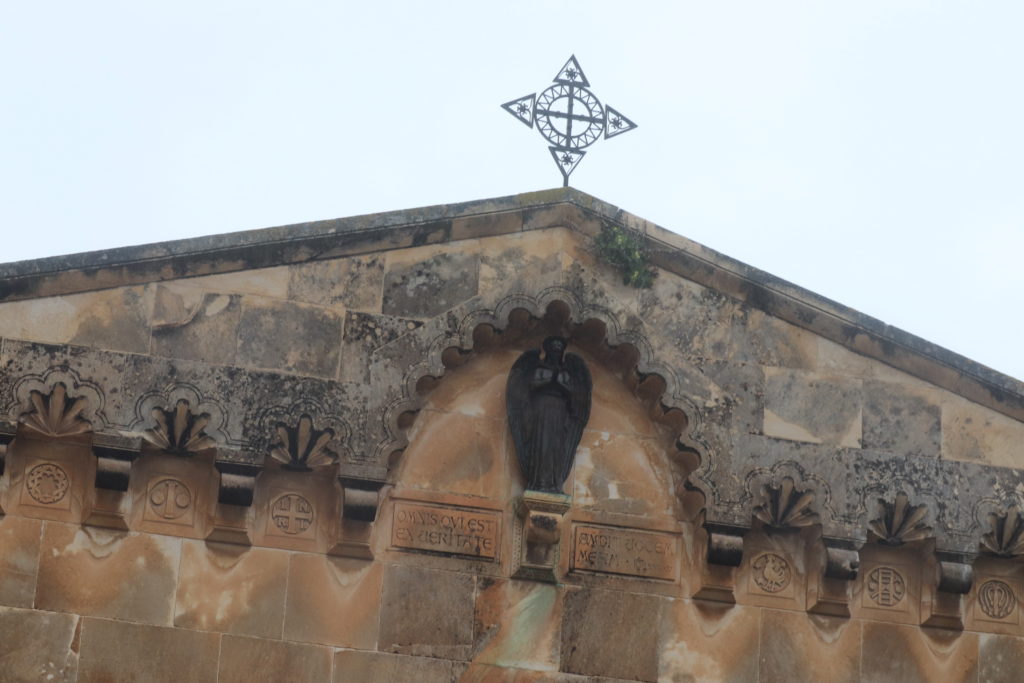
(Jerusalem) The Church of the Flagellation is a Roman Catholic church and Christian pilgrimage site located in the Muslim Quarter of the Old City of Jerusalem, Lions, Gate. This church marks the Second Station of the Cross and spot where Jesus Christ was flogged by Roman soldiers before his journey down the Via Dolorosa to Calvary. (Photo March 2020, Gina Brummett)
by aubree davis | Apr 9, 2020 | Devotions
Thursday of Holy Week was a day of agony for our Lord. The day started with him sending two of his disciples to prepare the upper room in Jerusalem for the Passover meal. In the evening He took a towel and basin and washed the feet of his disciples, demonstrating how believers should humble themselves and love one another. He shared the feast of Passover with disciples. As the Lamb of God, He was fulfilling the meaning of Passover by giving his body to be broken and blood to be shed in sacrifice, freeing us from sin and death. He instructed His followers to continually remember His sacrifice by sharing elements of bread and wine.
.After dinner he led the disciples into the Garden of Gethsemane at the Mount of Olives where He prayed. Luke 22:44 states that as He prayed “his sweat became like great drops of blood falling down to the ground.” His time of prayer was interrupted when Judas and a mob armed with swords and clubs, sent by the chief priests and elders of the people came and arrested him. He was taken to the home of Caiaphas the high priest where members of the Sanhedrin gathered to bring their accusations against him. There are twelve reasons why his arrest, trial and conviction were illegal.
- He was arrested without any formal charges presented against him.
- His trial was at night, when the law required it to be held during daylight.
- The Jewish law prohibited the Sanhedrin from originating changes.
- No witnesses were permitted to testify on his behalf.
- Jewish law did not permit the trial of a capital offense to begin on the day before the annual Sabbath of the Feast of Unleavened Bread.
- His trial was concluded in one day, when Jewish law stated that if a sentence of death was to be pronounced, the case cannot be concluded before the following day.
- Two false witnesses charged him with saying he would destroy the temple made with hands, yet the court condemned him on another false charge – blasphemy. According to the Jewish law, a person could not be condemned on his own testimony.
- The merits of His defense were not considered. Instead, the court pronounced sentence instantly and unanimously.
- Members of the court made sure the trial was completed before members like Joseph of Arimathea who would have voted against condemnation were present.
- The sentence was pronounced in the home of the high priest, when the law stated a death sentence could be pronounced only in the court’s appointed place.
- Most of the judges were known enemies of Jesus, when Jewish law called for judges to be impartial.
- The court legally switched the charges from blasphemy to treason before Pilate, a Roman crime, so the Romans would be responsible for his death. No evidence of treason was presented.
It was the immeasurable love of Christ that drove Him through the day of agony. I love, He washed the feet of the one who would betray him, and the one who would deny him. In love He gave himself over to the sentence of death, to die for the sins of all men including those who worked feverishly to have him killed. He was driven by His love for you and me.
Let’s sing: “For me it was in the Garden, He prayed “Not my will but Thine.” He had no tears for His own griefs but sweat drops of blood for mine. How marvelous, how wonderful! And my song shall ever be. How marvelous, how wonderful, is my Savior’s love for me.”
Scripture reading for Thursday: Matthew 26:17–75, Mark 14:12-72, Luke 22:7-62, and John 13:1-38.
by aubree davis | Apr 8, 2020 | Devotions
 This week I had an interesting discussion with my neighbor, who is an account executive and a committed Christian. She described the challenges working from home while we are trying to “slow the spread” of COVID-19. Sure, there are some issues with technology, but she said the greatest issues are “people issues”. When structure and strategy have been interrupted, there is tension, irritability and panic. We talked in general terms about how differently people respond who are in relationship with our Lord Jesus. His peace – and every fruit of the Spirit- is spotlighted in times like these. (See Galatians 5:22-24). My pastor husband says it this way: “The darker the dark the brighter the light!”
When I contemplate 1 Thessalonians 4:13 (…we do not grieve as those without hope) it occurs to me that this Scripture could apply to a number of emotions and experiences (i.e. anger, financial setbacks, health crises, etc.) Our Living Hope enables us to respond differently.
If we want to shame complainers, the stock illustration is the liberated but grouchy Israelites in search of their Promised Land. The following passage describes their crisis at Marah, where there was no fresh water.
So Moses brought Israel from the Red Sea; then they went out into the Wilderness of Shur. And they went three days in the wilderness and found no water. Now when they came to Marah, they could not drink the waters of Marah, for they were bitter. Therefore, the name of it was called Marah. And the people complained against Moses, saying, “What shall we drink?” So he cried out to the Lord, and the Lord showed him a tree. When he cast it into the waters, the waters were made sweet. (Exodus 15:22-25)
So what can we put into our difficult – even bitter –circumstances that will make life sweet again? For Moses it was a log (or tree). Symbolically, it is the same for us. The “tree” is Calvary’s Cross, where Jesus gave everything for us. Let’s invite Him into every situation.
As we approach Good Friday and Resurrection Sunday, remember that the bitter, polluted “waters” can be made sweet again by His presence.