by aubree davis | Apr 7, 2020 | Devotions
 On Tuesday of Holy Week, Jesus returned to Jerusalem, passed the withered fig tree and used it as an illustration of the power of placing our faith in God. When they returned to the Temple, religious leaders publicly challenged him, asking “By what authority are you doing these (miracles)? And who gave you this authority?” (Matthew 21:23). That conversation did not go well for the leaders, as Jesus called them “blind guides…whitewashed tombs full of dead people’s bones and all sorts of impurity, filled with hypocrisy and lawlessness…” (23:24-33). Notice, He did not try to defend himself nor give credence to his critics. There is probably a lesson there for us today. A little while later that day, Judas negotiated with the Sanhedrin to betray Jesus (Matthew 26:14-16).
In the afternoon Jesus returned to the Mount of Olives and gave a prophecy about the destruction of Jerusalem at the end of the age, His Second Coming and the final judgment. He was drawing the attention of his followers away from the drama and nonsense from unbelievers, to the plans God had in store for their future. I believe Jesus himself was looking past the agonizing events of the coming days, to the joy that was just around the corner.
In the evening, Jesus and the disciples returned to Bethany to spend the night.
Oh beloved, please don’t be preoccupied with the challenges of today. Don’t get lured into the fear and doubt that is so prevalent in our culture. Devour the word of God and keep your focus on His promises. Isaiah 26:3 reads “You will guard him and keep him in perfect and constant peace whose mind [both its inclination and its character] is stayed on You, because he commits himself to You, leans on You, and hopes confidently in You.”(AMP). God is faithful and His words are true. In the words of our Lord, “Heaven and earth will pass away, but my words will by no means pass away” (Matthew 24:35).
Let’s sing: “This world is not my home, I’m only passing through; my treasures are laid up somewhere beyond the blue. The angels beckon me from heaven’s open door, and I can’t feel at home in this world anymore…”
Scripture reading for Tuesday: Matthew 21:23–24:51, Mark 11:20–13:37, Luke 20:1–21:36, and John 12:20–38
by aubree davis | Apr 6, 2020 | Devotions
 This week in our daily devotions, we will consider the activities of our Lord during Holy Week.
On Monday, Jesus and his disciples walked the two miles from Bethany to Jerusalem. Along the way he cursed a fig tree because it had failed to bear fruit. There are two lessons to glean from this story. First it represented God’s judgment on spiritually dead religious leaders. In 2 Timothy 3:5 Paul warned Timothy of people with a “form” of godliness, but they deny the power. They go through the motions and maintain all the external form of religion, but know nothing of the power of God to genuinely change lives. Paul told Timothy to “turn away” from such people. In these troubling times, I pray for our community to find in the Church a true representation of the love and power that Almighty God has to offer. Secondly, He used this experience to illustrate the power of prayer and faith. According to Matthew 21:19 immediately after He cursed the tree it “withered away.” Jesus followed this up with the admonition “whatever things you ask when you pray, believe that you receive them and you will have them” (Mark 11:24).
In Jerusalem He returned to the Temple and saw two offenses. First, animals were being sold for sacrifices at exorbitant prices, and secondly, foreign money exchanged for temple gifts were subject to taxes and a high exchange rate. Both of these offenses were for the financial benefit of the priests and Pharisees. In anger, Jesus overturned tables and drove the money changers out, saying “The Scriptures declare, ‘My Temple will be a house of prayer,’ but you have turned it into a den of thieves” (Luke 19:46).
I can’t help but see a parallel between Jesus cursing a barren fig tree and rebuking religious leaders for failing the people while padding their bank accounts. God wanted the temple to be a house of prayer for all people, not just the wealthy. He still does.
Let me encourage you, that in a culture of spiritual barrenness, we can be believers who take God at His word, pray in faith, and believe Almighty God to do the miraculous.
Scriptures for Monday: Matthew 21:12–22, Mark 11:15–19, Luke 19:45-48, and John 2:13-17.
by aubree davis | Apr 3, 2020 | Devotions

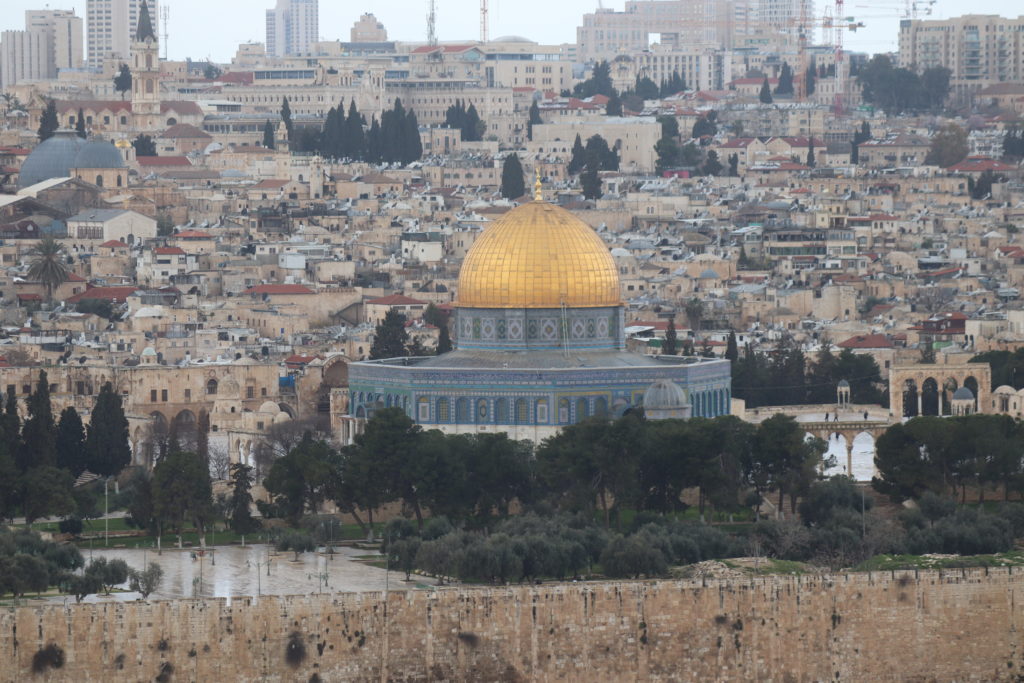
A night view of Jerusalem from atop the Mount of Olives was our special treat only a few of hours after arriving in Israel. Majestic and beautiful only begin to describe the scene. When we returned in the daylight, this iconic view of Jerusalem was equally inspiring, looking across the Kidron Valley to the Old City landmarks (Temple Mount, Church of the Holy Sepulcher, Russian Orthodox Church of Mary Magdalene and more).
The Mt. of Olives is the location where Jesus spent much of His last week on earth; it is the site from which He ascended to heaven after His resurrection, and where He will one day return to earth. It is somewhat surreal to stand in this spot as you remember its history and look forward to its future.
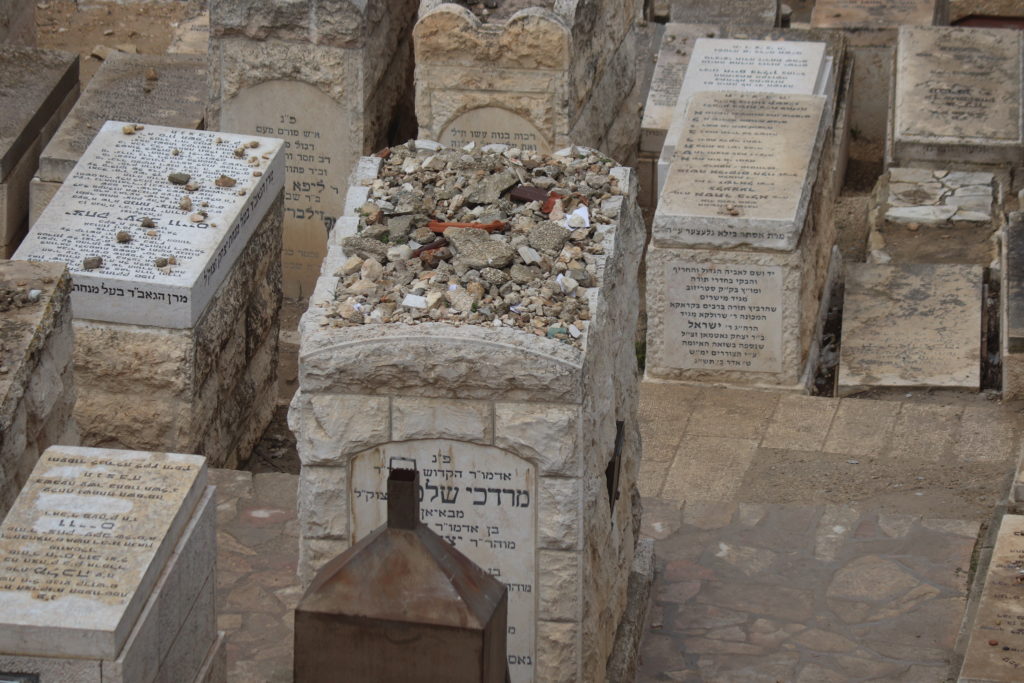
Another cause for wonder in this place is the Jewish cemetery covering the slopes of the Mount of Olives. The cemetery contains anywhere between 70,000 and 150,000 tombs from various periods, including the tombs of famous figures in Jewish history.
We noticed rocks and pebbles piled on the graves – some more than others. We learned that Jewish tradition is to place rocks, rather than flowers, whenever the grave is visited. This lets the family know that someone cared enough to visit the grave. It communicates that the loved one is still thought about and missed. A logical conclusion might be more rocks = more love and respect for the departed.
Hopefully, the same respect was given during the person’s lifetime. Some have said (maybe in jest but with an element of sincerity), “Don’t send flowers when I die; bring them while I’m alive!” The Scriptures instruct us to pay special attention to the way we honor others, especially our elders, our Christian brothers and those in authority.
Honor your father and your mother, so that you may live long in the land the Lord your God is giving you. (Exodus 20:12)
Be devoted to one another in love. Honor one another above yourselves. (Romans 12:10)
Honor all people. Love the brotherhood. Fear God. Honor the king. (1 Peter 2:17)
So whether we’re talking about rocks or flowers, a good rule to follow is that we express our devotion sincerely while there is opportunity.
by aubree davis | Apr 2, 2020 | Devotions
.Romans 1:8 First, I thank my God through Jesus Christ for you all, that your faith is spoken of throughout the whole world.
One of the greatest memories I have from our recent trip to Israel was the time spent in reading the word, worship and prayer with fellow believers. The number of people in Israel who are followers of Christ are few, which means relationships between believers is precious and appreciated.
In our condo in Jerusalem we read scripture, sang and prayed before visiting the Mount of Olives. In the days that followed we also read the scriptures at places like Beth-Shemesh where the Philistines returned the Ark of the Covenant to the Jews (1 Samuel 6), and the Valley of Elah where David killed Goliath (1 Samuel 17). Sharing these times of worship and prayer with Gina’s cousins Jeanie, Scott, and Laura were precious. Scott and Laura lived in Israel for nine years, pastoring and planting churches. We had the privilege of participating in a Bible study and prayer meeting in one of those churches, in the city of Qiryat Shemona, located near the Lebanese border. To the best of our knowledge it is the only Christian congregation north of the Sea of Galilee. You can imagine our relief when they opted to speak in English rather than Hebrew during our meeting.
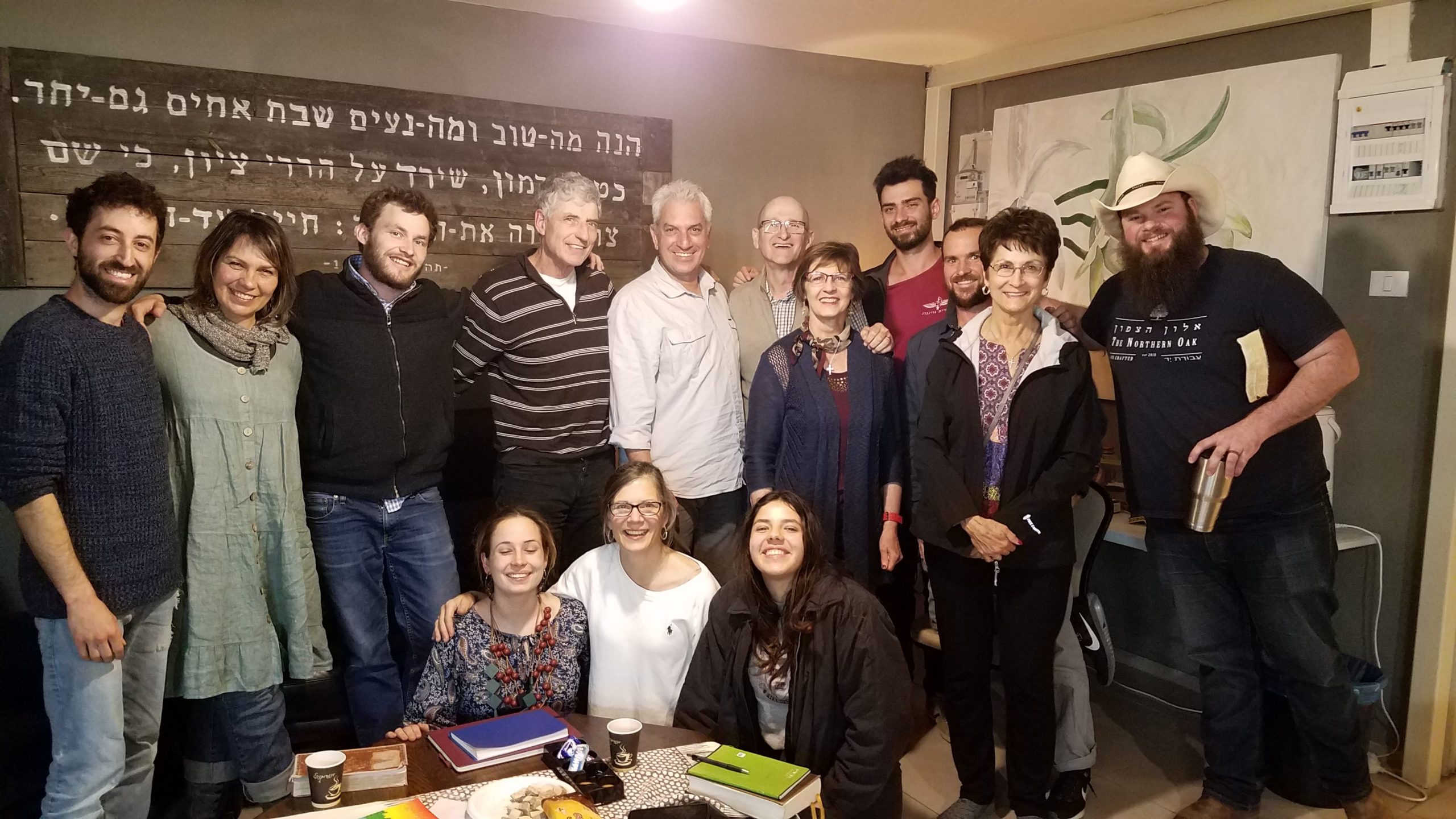
The pastor’s name is Israel, the gentleman in the white shirt standing to my right in the photo, and his wife Marci is the lady in the green dress on the far left of the photo. Israel’s father was a rabbi. When Israel came to Christ he was the first Christian in his village. Standing to his right is Daniel from the village of Metula located on the Lebanese border. He and his wife are the only believers in their community. Daniel has a gentle spirit and a genuine love for God and the Bible. The gentleman in the cowboy hat is Zach, from Pastor Robert Morris’ church in Texas. Zach moved to Israel years ago, and attended the church Scott and Laura planted in Tel Aviv. He is a gifted carpenter who used his skills to paint and remodel the church building. Others were from South Africa and Lithuania.
I can’t tell you the theology of those I worshipped with that night, other than they all believed in Jesus Christ the Son of God who died on the cross for our sins; they believed in the authority of God’s Word and they believed in the power of prayer.
Pastor Israel led an hour-long discussion on the scriptures, and afterward we spent an hour in prayer. Brothers and sisters whom we met only an hour before prayed aloud for Gina’s brother Ron who is in Craig Hospital paralyzed from a motorcycle accident. They prayed for Gina and me and our congregation, and they prayed for their friends and relatives who are not saved. We were deeply moved, knowing “the fervent prayer of a righteous man accomplishes much” (James 5:16). As we prayed, the sweet aroma of the presence of the Holy Spirit filled that place. Oh, how it filled that place and our hearts.
I am praying for the presence of the Holy Spirit to fill your hearts and homes and you spend time with Him in your prayer closet.
Let’s sing: O come to the altar, the Father’s arms are open wide…
by aubree davis | Apr 1, 2020 | Devotions
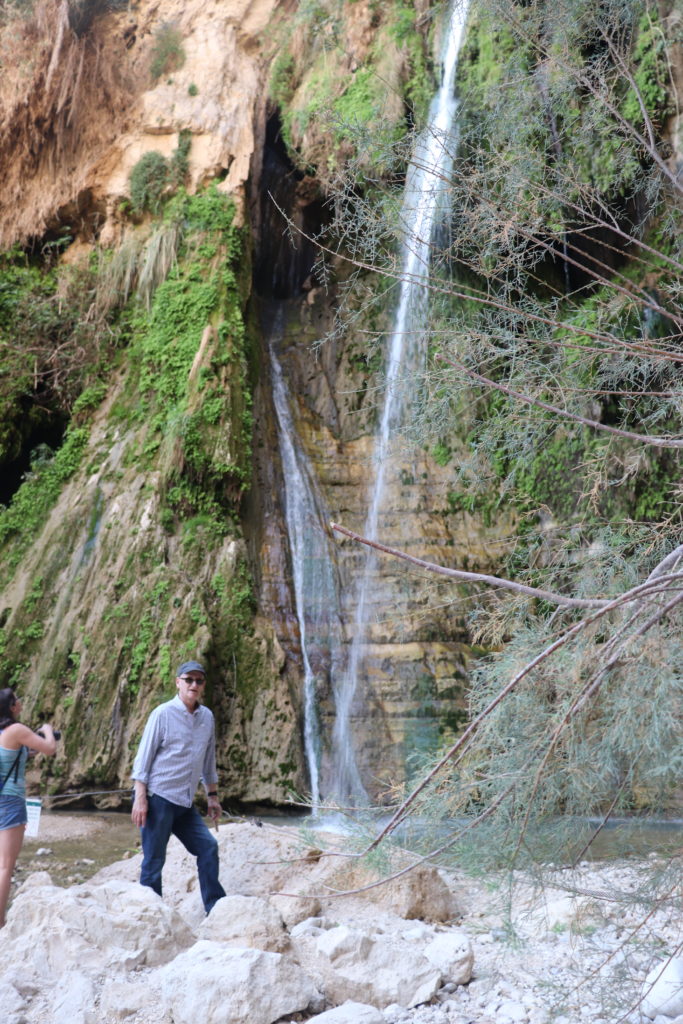
Waterfall at En Gedi National Reserve
We tracked a LOT of steps touring Israel, and a couple of times I took a picture of my foot (dipping my toe into the Sea of Galilee, for example). Very often and in many places I mused, “Just think, I’m stepping right where [Bible character] did!” That happened as we hiked the En Gedi Nature Reserve, and we talked about David hiding there from King Saul. (1 Samuel 24)
King Saul, paranoid and jealous of David’s success and rising popularity, was searching for David to take his life. If it were a movie, this would be one of the cliff hangers, with a little comedy thrown in. Saul is scouring the landscape and suddenly needs a “pit stop”. He darts into a cave, and amazingly it is the same cave where David and some of his men are hiding. While Saul’s guard (and his garments) are down, David creeps near him with the incredible opportunity to save his own life by taking Saul’s! But David, at the last second, redirects his spear and slices off a corner of Saul’s robe. The Bible tells us that David was ashamed of himself as he held that slice of cloth and envisioned what he had nearly done – taken the life of his king.
Oblivious, Saul leaves the cave to resume his search, and David runs out into the open air, calling after Saul. Desperately trying to convince Saul that he means him no harm, David produces the patch of cloth. Saul must have turned as white as the foamy water cascading down the nearby cliff as he grabbed his robe and verified his close call with death.
Actually, I think both men were dumbfounded as they held in their hands evidence of “what almost was”. I wonder if that bit of Saul’s robe ended up somewhere that David saw it often and remembered that God kept him from an action that he would regret. I wonder if Saul refused to have the robe mended, so that he would remember David’s mercy. The succeeding chapters reveal other occasions when David remembered to be merciful (and times when Saul forgot).
Still, a swatch of fabric reminds us about mercy. I like mementos (hence the sneaker photos), and I’m thinking that Jesus likes mementos, too. He gave us the idea – command, actually – to partake of communion together as a reminder of His sacrificial death. (Matthew 26:26; 1 Corinthians 11:26) “As often as we do it”, we hold in our hands a little juice and bread as evidence that “what almost was“ (our death penalty) mercifully was replaced by eternal life.